Turning Founder Dynamics into an Advantage for U.S. Market Entry
\ CASE STUDY
IN PARTNERSHIP WITH

"I enjoyed learning about INSI and how it can apply to building a stronger team profile. I’m interested in exploring INSI with some of our managers at our company.”
— Jae Han, Sales Director for Ecube Labs and KIC StartX Cohort Participant
Background
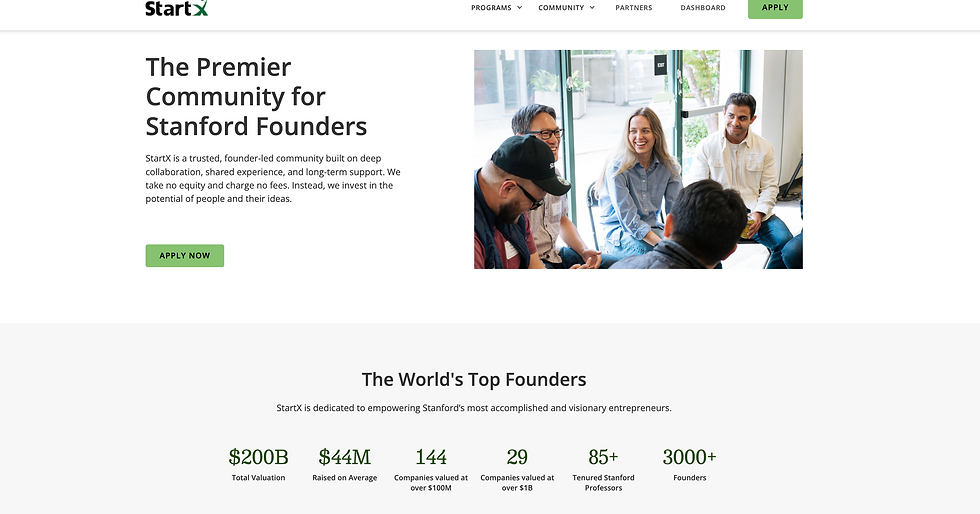
StartX is a nonprofit founder community that has supported Stanford-affiliated entrepreneurs for more than 15 years. Its model does not take equity or charge founders. Instead, experienced founders, mentors, and partners give back to help the next generation build durable companies.
StartX has supported roughly 1,500 startups and 3,000 founders through its core cohorts and a growing portfolio of international programs. These tailored programs bring founders and senior executives from markets including Korea, Japan, and Kazakhstan into Silicon Valley to strengthen their networks, test assumptions, and prepare for U.S. growth.
For the July 2026 Korea Innovation Center (KIC) cohort, StartX wanted to give participating founders more than market-entry content. It wanted a practical way for founders and their team members to understand how they made decisions, responded to uncertainty, work together, and translate advice into action.
The Challenge
StartX already had a strong mentor network and a flexible, founder-led program model. The harder task was making the human dynamics behind company execution visible early enough to shape the cohort experience.
-
Limited visibility: Program leaders and participants lacked a shared view of the decision styles, strengths, and blind spots founders would bring to U.S. market-entry work.
-
Hidden team friction: Differences in speed, risk tolerance, experimentation thresholds, and decision-making could slow company pairs when the pressure to learn and act increased.
-
Dynamic program design: StartX tailored each international program to the cohort, but needed cohort-level evidence to connect participants, integrate interactivity into the curriculum, and address the cultural nuances of US market expansion.
-
Untapped peer complementarity: The cohort included a wide range of innovation styles, yet participants had no consistent method for learning from founders or other participants whose strengths differed from their own.
-
Insight without action: Self-awareness would have limited value unless founders connected it to a specific leadership behavior or market-entry experiment.
Our Approach
C\R Strategy partnered with StartX to embed the Innovation Navigation Styles Inventory (INSI) into the KIC accelerator kickoff. All 15 participants completed INSI beforehand. The two-hour workshop used individual, company, and cohort data to turn founder dynamics into practical choices for U.S. scaling.
The work followed five connected steps:
-
Diagnose: Participants completed the 16-question INSI assessment and reviewed individual results to identify strengths, surprises, blind spots, and patterns that could shape their leadership under pressure.
-
Compare: Company pairs participating in the StartX program discussed where their styles aligned, where they differed, and how those differences could create either momentum or friction during U.S. market entry.
-
Map: The cohort readout showed the group’s shared strengths and development needs, giving StartX evidence it could use to tailor the program experience.
-
Connect: Cross-company pairings matched participants with complementary styles so founders could exchange strategies outside their usual way of working.
-
Apply: Each participant selected a small, time-bound behavior or experiment tied to a current U.S.-scaling decision.
The workshop was designed for an international cohort: participants wrote before speaking to reduce language and status effects, worked first with their company partner, then mixed across companies, and ended with a concrete commitment. INSI was presented as a mirror for current behavior not as a fixed personality test, a ranking, or a definition of the “right” founder profile.
Learning & Outcomes
The KIC cohort readout gave StartX and participating founders a clearer picture of how the group could use its strengths while addressing the patterns most likely to slow U.S. market progress.
-
Range of styles: The cohort represented a broad mix of innovation approaches. Many participants leaned toward Creation and Scrappiness, while others contributed stronger Strategy and Growth orientations.
-
Customer orientation: The group showed strong empathy and an outward focus which are useful strengths for testing assumptions about U.S. buyers, users, and partners.
-
Exploration strength: Participants were comfortable generating options and seeking external input. The next step was narrowing those options into experiments that answered specific business questions.
-
Execution discipline: The main cohort opportunity was converting exploration into scalable execution through clearer priorities, evidence thresholds, decision rights, and learning cycles.
-
Team awareness: The readout made differences in preferred speed, risk tolerance, and decision style discussable before those differences became operating friction.
-
Resilient learning: Participants showed resilience and openness to advice. The workshop reinforced the need to convert setbacks and mentor input into stronger internal judgment.
The Results
The engagement produced a practical founder-development layer for the KIC program. Each result directly addressed one of the five original challenges:
-
Founder patterns made visible: To address limited visibility, participants received individual INSI readouts and StartX received an aggregated cohort view of strengths, blind spots, and decision patterns.
-
Company dynamics surfaced early: To address hidden team friction, company pairs compared how they approached speed, risk, evidence, and decisions, then identified where their differences could complement or constrain execution.
-
Cohort needs translated into program insight: To strengthen dynamic program design, the cohort analysis identified clear themes for mentors, curriculum, and office hours: build on customer empathy and exploration while strengthening prioritization, scalable execution, and explicit decision processes.
-
Peer learning organized around complementarity: To use the cohort’s untapped peer complementarity, participants worked across companies with founders who brought different innovation styles and exchanged approaches they could test in their own businesses.
-
Reflection converted into a next move: To prevent insight without action, participants ended the workshop with a small, time-bound leadership behavior or market-entry experiment tied to an active company decision.
StartX emerged with a repeatable way to add founder and team intelligence to an international accelerator cohort. The July 2026 workshop established a foundation StartX can reuse when shaping mentor support, cohort pairings, and program design while keeping founder action at the center.